
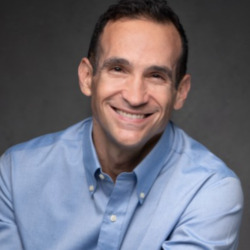
Nir Eyal is a bestselling author, behavioral science expert, and keynote speaker who helps individuals and organizations understand how psychology and technology shape human behavior. He is the author of the bestselling books Hooked, Indistractable, and Beyond Belief, which have sold over one million copies, been translated into over 30 languages, and earned recognition from The New York Times, Amazon, Audible, and The Globe and Mail.
A former Stanford Graduate School of Business lecturer, Nir has worked with organizations, including JPMorgan Chase and the US Air Force and invested in companies including Canva and Kahoot. He helps people build better habits, improve focus, and reach their full potential.






Here’s a glimpse of what you’ll learn:
- [4:23] Nir Eyal discusses why he wrote Beyond Belief
- [9:35] How your beliefs shape what you see, think, and achieve
- [14:45] Serena Williams, confidence, and the power of liberating beliefs
- [18:20] The three qualities every impactful book should have: useful, true, and novel
- [20:53] Why popular psychology studies and personality tests can be misleading
- [25:39] A simple technique to reframe relationship challenges and improve communication
- [36:13] How the turnaround method helps transform limiting beliefs into empowering ones
- [41:59] Third-person self-talk as a tool for confidence and psychological distance
In this episode…
Why do some people turn knowledge into lasting change while others remain stuck in the same patterns? We have access to more books, podcasts, and expert advice than ever before, yet lasting transformation often feels out of reach. If information isn’t the problem, what is the missing piece that drives real change?
Nir Eyal, bestselling author and behavioral science expert, says lasting change begins by examining the beliefs behind our actions. He explains that sustained motivation depends not only on knowing what to do and understanding the benefits, but also on having beliefs that support persistence. Rather than treating beliefs as fixed truths, Nir encourages viewing them as tools that can be tested and reshaped. He illustrates this through examples ranging from Serena Williams’ coach using “belief hacking” to build confidence to Amazon’s “Day One” philosophy of continual innovation. He also shares practical methods, including inquiry-based stress reduction, to help people challenge limiting beliefs, improve relationships, and unlock greater personal and professional potential.
In this episode of the Inspired Insider Podcast, host Dr. Jeremy Weisz sits down with Nir Eyal to discuss how beliefs shape performance, leadership, and personal growth. They explore why persistence matters more than talent, how leaders cultivate empowering beliefs, and practical ways to reframe limiting mindsets. Nir also shares why questioning common psychological assumptions can lead to better decisions and lasting change.
Resources mentioned in this episode:
- Nir Eyal on LinkedIn
- Nir and Far
- Beyond Belief: The Science-Backed Way to Stop Limiting Yourself and Achieve Breakthrough Results by Nir Eyal, Julie Li
- The E-Myth Revisited: Why Most Small Businesses Don’t Work and What to Do About It―A Guide to Starting a Business in a Productive and Successful Way by Michael E. Gerber
- Traction: Get a Grip on Your Business by Gino Wickman
- 80/20 Sales and Marketing: The Definitive Guide to Working Less and Making More by Perry Marshall, Richard Koch
- Essentialism: The Disciplined Pursuit of Less by Greg McKeown
- Stand Out: How to Find Your Breakthrough Idea and Build a Following Around It by Dorie Clark
- Alchemy: The Dark Art and Curious Science of Creating Magic in Brands, Business, and Life by Rory Sutherland
- Hooked: How to Build Habit-Forming Products by Nir Eyal
- Indistractable: How to Control Your Attention and Choose Your Life by Nir Eyal
- Molecules Of Emotion: The Science Behind Mind-Body Medicine by Candace B. Pert
- Malcolm Gladwell Books
- ChatGPT
- Indistractable Bonus Content
- “The Most Important Skill of the Future is Being ‘Indistractable’”
- “Timeboxing: Why It Works and How to Get Started in 2025”
- “The Ultimate Core Values List: Your Guide to Personal Growth”
- “Getting Over FOMO, the Fear of Missing Out”
- “Are You a Wage Slave?”
- “Habit Tracker Template in Google Sheets”
- “Schedule Maker: a Google Sheet to Plan Your Week”
- “36 Interesting Articles to Stimulate Your Mind”
Special mention(s):
- The Work Of Byron Katie
- Every Cure
- David Fajgenbaum on LinkedIn
- Patrick Mouratoglou on LinkedIn
- Serena Williams on LinkedIn
Related episodes:
- “Leading with Passion with Gino Wickman Founder of EOS Worldwide ” on Inspired Insider Podcast
- “How to Craft a Compensation Plan that Attracts and Motivates the Right People For Your Company With Verne Harnish, Owner Scaling Up” on Inspired Insider Podcast
- “[Sweet Process Series & Top Author Series] How to Make Your Business the Next McDonalds of Your Industry with Michael E. Gerber Author of The E-myth” on Inspired Insider Podcast
- “[Top Author Series] Does God Exist? with Perry Marshall author of Evolution 2.0” on Inspired Insider Podcast
- “[Top Author Series] The Essentialism Movement with Greg McKeown Author of “Essentialism” & Founder of ThisInc.co” on Inspired Insider Podcast
- “[Top Author Series] How to Create Your Breakthrough Idea with Dorie Clark, Author of “Stand Out”” on Inspired Insider Podcast
Quotable moments:
- “Persistence doesn’t guarantee success, but quitting guarantees failure.”
- “Beliefs are tools, not truths.”
- “Beliefs are open to revision based on evidence.”
- “Suffering isn’t a fact — it’s a belief.”
- “If we had unlimited motivation, what couldn’t we accomplish?”
- “We don’t see people as they are; we see them through our beliefs.”
Action steps:
- Identify and challenge limiting beliefs to unlock new possibilities: Question the assumptions that keep you stuck and explore alternative perspectives that support growth and progress.
- Choose empowering beliefs that fuel persistence: Treat them as tools rather than fixed truths, and adopt mindsets that strengthen your motivation and resilience in the face of setbacks.
- Practice the turnaround technique to build emotional resilience: Reframe stressful thoughts by examining the beliefs behind them, reducing unnecessary suffering and improving your response to challenges.
- Use third-person self-talk to gain clarity and confidence: Create psychological distance by speaking to yourself as you would a trusted friend, leading to more objective thinking and better decisions.
- Focus on persistence over perfection: Reinforce beliefs that strengthen your sense of agency, helping you stay committed to your goals even when progress feels slow.
Sponsor for this episode
At Rise25 we help B2B businesses give to and connect to your ‘Dream 200’ relationships and partnerships.
We help you cultivate amazing relationships in 2 ways.
#1 Podcasting
#2 Strategic Gifting
#1 Our Predictable Podcast ROI Program
At Rise25, we’re committed to helping you connect with your Dream 200 referral partners, clients, and strategic partners through our done-for-you podcast solution.
We’re a professional podcast production agency that makes creating a podcast effortless. Since 2009, our proven system has helped thousands of B2B businesses build strong relationships with referral partners, clients, and audiences without doing the hard work.
What do you need to start a podcast?
When you use our proven system, all you need is an idea and a voice. We handle the strategy, production, and distribution – you just need to show up and talk.
The Rise25 podcasting solution is designed to help you build a profitable podcast. This requires a specific strategy, and we’ve got that down pat. We focus on making sure you have a direct path to ROI, which is the most important component. Plus, our podcast production company takes any heavy lifting of production and distribution off your plate.
We make distribution easy.
We’ll distribute each episode across more than 11 unique channels, including iTunes, Spotify, and Amazon Podcasts. We’ll also create copy for each episode and promote your show across social media.
Cofounders Dr. Jeremy Weisz and John Corcoran credit podcasting as being the best thing they have ever done for their businesses. Podcasting connected them with the founders/CEOs of P90x, Atari, Einstein Bagels, Mattel, Rx Bars, YPO, EO, Lending Tree, Freshdesk, and many more.
The relationships you form through podcasting run deep. Jeremy and John became business partners through podcasting. They have even gone on family vacations and attended weddings of guests who have been on the podcast.
Podcast production has a lot of moving parts and is a big commitment on our end; we only want to work with people who are committed to their business and to cultivating amazing relationships.
Are you considering launching a podcast to acquire partnerships, clients, and referrals? Would you like to work with a podcast agency that wants you to win?
Rise25 Cofounders, Dr. Jeremy Weisz and John Corcoran, have been podcasting and advising about podcasting since 2008.
#2 Our Comprehensive Corporate Gifting Program
Elevate business relationships with customers, partners, staff, and prospects through gifting.
At Rise25, thoughtful and consistent gifting is a key component of staying top of mind and helps build lasting business relationships. Our corporate gift program is designed to simplify your process by delivering a full-service corporate gifting program — from sourcing and hand selecting the best gifts to expert packaging, custom branding, reliable shipping, and personalized messaging on your branded stationary.
Our done-for-you corporate gifting service ensures that your referral partners, prospects, and clients receive personalized touchpoints that enhance your business gifting efforts and provide a refined executive gifting experience. Whether you’re looking to impress key stakeholders or boost client loyalty, our comprehensive approach makes it easy and affordable.
Discover how Rise25’s personalized corporate gifting program can help you create lasting impressions. Get started today and experience the difference a strategic gifting approach can make.
Email us through our contact form.
You can learn more and watch a video on how it works here: https://rise25.com/giftprogram/
Contact us now at [email protected] or message us here https://rise25.com/contact/
Powered by Rise25 Podcast Production Company
Insider Stories from Top Leaders & Entrepreneurs…
Episode Transcript
Intro 00:15
You are listening to Inspired Insider with your host, Dr. Jeremy Weisz.
Dr. Jeremy Weisz 00:22
Dr. Jeremy Weisz here. I am the Founder of InspiredInsider.com, where I talk with inspirational entrepreneurs and leaders. Today is no different. I have Nir Eyal and you know, his latest book is Beyond Belief, which we’ll get into. He has other books as well, which I’ll talk about. Nir, before I formally introduce you, I always like to point out other episodes of the podcast people should check out. You know, since this is part of the Top Author Series and I’m going to, I want to know about what your favorite books are to obviously outside of yours. But on the Top Author Series, Gino Wickman of Traction, that was a popular one, Verne Harnish of Scaling Up, Michael Gerber of the E-Myth, one of my favorites, probably lesser known, Perry Marshall’s 80/20 Sales and Marketing is up there. You know, the list goes on and on., Greg McKeown, Essentialism. there’s just a lot of good ones. Dorie Clark, Stand Out, yeah. What are some of your favorite books of all time? I love how you mentioned Hooked.
Nir Eyal: 01:21
You know, some of my favorites, these are my, some of my favorite friends, not just my favorite authors. So it’s great that you’ve had so many of my friends on the show. That’s wonderful. I think one book that hasn’t been read enough that I got a lot out of, I think your audience might enjoy as well., is Rory Sutherland’s book Alchemy. I really enjoyed that one.
Dr. Jeremy Weisz: 01:38
Okay. Did he do,. Does he have another book too?
Nir Eyal: 01:46
I don’t know, okay. I don’t think so. I think he’s writing another book, but I think so far he’s just published one, if I’m not mistaken.,
Dr. Jeremy Weisz: 01:52
Maybe I’m thinking of another one. It’s like. Yeah., Alchemy. I’ll check it out. That’s great. So before I formally introduce, this episode is brought to you by Rise25. At Rise25, we help businesses connect to their dream relationships and partnerships. We do that in two ways. One, we’re an easy button for a company to launch and run a podcast. We do the strategy, accountability and the full execution. And then two, an easy button for a company’s gifting. So we make gifting and stay top of mind to be clients, partners, prospects, even staff. From a culture perspective, just give us a list of addresses and we’ll do everything else. And it’s not like a one off gift. It’s everything every four months for like four years, right? So for me, you know, the number one thing in my life is relationships. I’m always looking at ways to give to my best relationships. And I found no better way to profile the people I admire in the podcast and send them sweet treats in the mail. So you can check out Rise25.com or email [email protected].
I’m super excited to introduce Nir. He’s been mentioned on the podcast many times. Actually, for his previous books, he’s a best selling author, speaker, behavioral design consultant. He spent his career at the intersection of psychology, technology, and human potential, which you can, you know, gather from listening to his books. His books Hooked: How to Build Habit-Forming Products and Indistractable: How to Control Your Attention and Choose Your Life have been really translated into dozens of languages and have really shaped how companies think about product design and productivity.
Now, his book Beyond Belief, which I actually just listened to, explores how our beliefs function as powerful tools that can either limit or liberate us. You know, for me, that’s a special place in my heart. I, my background is in biochemistry as a chiropractor. So studying how the body works and the mind works is I remember listening to reading Candace Pert’s, Molecules Of Emotion, decades ago. And, the mind is a powerful thing. So near has taught at Stanford’s Graduate School of Business School and has consulted with major organizations, and his work has been featured all over the place Harvard Business Review, etc. So yeah, thanks for joining us.
Nir Eyal: 04:11
My pleasure. Jeremy. Great to be here.
Dr. Jeremy Weisz: 04:12
You know, when I was listening to the book, right. And you have other best selling books like we mentioned. I’m just thinking, why did he choose this topic?
Nir Eyal: 04:23
Yeah, the reason is simple. I got some funny phone calls and here’s what the call sounded like. So every week I do calls with my readers. I have these office hours I call them, and every week, one Wednesday night, anyone can call me and I do four calls every week. And if you’ve read one of my books and you have a question, I love talking to my readers. And a few years ago, after I wrote Indistractable, people started calling me with kind of a funny question. They would say, Hey Nir, you know, I read Indistractable. I read it cover to cover. I really enjoyed it. The thing is, is that it didn’t work for me and I’d say, oh wow, tell me more. You know, I’m so curious. I spent five years writing that book. There are 30 pages to peer review.
Dr. Jeremy Weisz: 05:03
I only poured thousands of hours in it, so.
Nir Eyal: 05:06
No, no, not so much. It was genuine curiosity. No, totally no intent at all. I was really curious because it’s changed my life. You know, I’m very research backed. I want to. I know that it works in peer reviewed studies, but I need to see myself that it works. And it’s absolutely changed my life to become Indistractable. And so when I spoke to folks, I’d say, you know, let’s walk step by step because I want to figure out where it didn’t work for you. I can learn from that. And so I’d say, let’s start with step one. How did step one go for you? And they’d say, oh, you know what? I read step one. I definitely read it. It’s just that I didn’t do it. And I’d say, okay, no problem. Maybe you skipped step one. How about step two? How did step two go for you? And they’d say,, yeah, you know what, Nir? I definitely read step two.
I remember that one. I really liked that one. It’s just that I didn’t do that one either. And, here I was kind of scratching my head. Why is it that people would wait for months to talk to the author of a book that they had read, but hadn’t actually done anything about, and so they wanted to tell me the book they read didn’t do anything with didn’t work. And so I, I kind of, you know, at first I thought, is it my readers? Is it my writing? You know, did I write a bad book? What happened here? And then I realized, wait a minute. I have dozens of books that I’ve read and haven’t done anything with. I’ve paid gurus and experts to give me advice that I’ve neglected. I’ve listened to podcasts and YouTube videos giving me amazing tips and tricks and haven’t done much with them. Why? Why is it when we live in an age of so much information abundance, we are drowning in information?
I mean, there’s lots of reasons people don’t do what they say they’re going to do. Not knowing what to do is not one of them anymore. Because if you don’t know what to do, buy a book, ask ChatGPT, Google it. The answers are all out there. So the question is no longer, why don’t we do what we say we’re going to do? We have the information. The question is why do we keep getting in our own way? And so I wanted to figure out, well, why is it that even when we know exactly what to do, the behavior and we want the benefits of doing it, why don’t we do. And so that’s really the premise of why I got started. And of course, you can tell by the title of the book, I found the answer after six years researching and writing this book, is that our model of motivation is incomplete, that we think that motivation is like a straight line between behavior and benefit. Right.
I was an E-con major in college, and they teach you that in order to, to, to, to, inspire a behavior, you just need an incentive that if you tell someone what to do the behavior and you give them the benefit, the incentive, well, they’re going to do it. But we know it’s not that simple.If it was that easy, then we would all have six pack abs and be multi-millionaires. That motivation is not a straight line. Motivation is a triangle. That in order to sustain our motivation, we need to not only know what to do, the behavior. We not only need to know the benefit, why we’re doing it, but most importantly, we have to have the belief. The belief is what holds it all together.
For example, if you don’t believe that your boss is going to give you that promotion, maybe you don’t believe they have your best interest at heart. Maybe you don’t believe in their leadership. Well, how motivated are you going to be to work hard for them? If you don’t believe in them, not very. You’re going to find another boss. You’re going to quit at some point. Conversely, even if you know exactly what to do, you know exactly the steps, the behavior you need to take. If you don’t believe in your own ability to do it, you also won’t sustain your motivation and you’re going to quit. So in order to sustain our motivation over the long term, which turns out to be the most important trait of whether you will accomplish your goals, it’s not how smart you are.
It’s not whether you have the right information. It’s not your skill. It’s not your resources. Turns out the most important trait is whether or not you will quit. That’s it. It’s persistence. Persistence doesn’t guarantee success, but quitting guarantees failure. So if we can hack into that, if we can have unlimited motivation to pursue our dreams, what can’t we accomplish? And so in order to do that, we have to understand our beliefs.
Dr. Jeremy Weisz: 09:06
I’m curious how leaders have used this? Obviously, this has a lot of applications from health to business. And you know, from a leadership perspective, I always think, well, like you said, we can if the team believes in a lot of its vision, you know, the Gino Wickman visionary integrator setting the vision as a leader. So how have leaders used beyond belief or some of the principles to grow their business?
Nir Eyal: 09:35
Yeah, it’s interesting that you say you should say vision because one of the things you hear people say, one of the idioms that’s often tossed around is that I’ll believe it when I see it, but it turns out that the opposite is just as true, that it’s not just that seeing is believing is that your beliefs change what you see. Literally. I’m not, it’s not figurative. It’s not metaphorical. It is literally true that people who are afraid of heights will see distances as further away, that people who are on a diet see food as larger. That I can show two people what’s called a coffer illusion and based on where they grew up, one group of people will see rectangles, the other will see circles. Same image. So our beliefs literally change what we’re able to see. And so when it comes to a leadership type role, developing that vision is incredibly important.
Now let’s probably define our terms here. You know, we use beliefs and facts interchangeably, but beliefs are not facts. A fact is an objective truth. It is something that is true whether or not you believe in it. The world is more like a sphere than it is flat. Sorry if you have any flat earthers in your audience, but effect is effect. We cannot change facts. On the other end of the spectrum, we have faith. Faith is a conviction that does not require evidence. God rewards the righteous. There’s no amount of evidence that’s going to change someone’s mind on that, nor should it. It’s a matter of faith. But between fact and faith is what we call a belief. A belief is a conviction that is open to revision based on evidence. I’m going to say it again because it’s so important.
A belief is a conviction that is open to revision based on evidence. And what makes belief so powerful and why I think they’re underutilized is that unlike faith, which people almost never change. And unlike facts, which you cannot change, a belief is open to revision. You can change your beliefs. Beliefs are not facts. And the most important thing I can leave you with is this. Beliefs are tools, not truths. Okay, I’ll say it again. Beliefs are tools, not truths. So in a leadership context, you can leverage beliefs that are not true. What am I saying here? Am I telling you to lie to people? Am I telling you to gaslight yourself? Am I telling you to be delusional? Well, I would argue you’re already lying to yourself. You’re already delusional.
You think you can see reality clearly? You can’t. It’s impossible. None of us can see reality as it is. We see reality filtered by our beliefs. Have you ever noticed that you can’t spell belief without a lie? It’s right there in the middle of the word. BELIEF. You cannot spell belief without a lie. It’s right in the middle of the word. And let me give you an example of how corporations do this all the time. Amazon. If you’ve ever if you know anybody who’s worked at Amazon and Amazonian, they all memorize these 16 leadership principles. Everybody knows them like the back of their hand.
They’re all memorized. Now, one of these leadership principles is it’s always day one. Okay. At Amazon, it’s always day one. Now, does that strike you as odd that that is factually a lie? It is not day one. It has not been day one for a very, very long time. The company is worth, what, over $1 trillion? Today is not day one. It is not a startup. But why do they keep repeating it? In fact, they will make decisions based on this lie. You know, you’ll hear people in meetings over email saying, hey, that’s not what we would do here. Because, you know, at Amazon, it’s always day one. So why do they say it? Well, because beliefs are tools, not truths. It helps focus their behavior and their motivation to do those said behaviors based on that belief.
And so as a leader, not only individually, I mean, the best way to lead, of course, is through your example, but in terms of how we motivate people to persist, understanding how beliefs these three powers of belief, how belief changes what you see literally what you see, how you feel. Not only your feelings, but your physiological state as well. Your beliefs directly affect your pain and suffering and most importantly, the sense of agency. What? The power of beliefs to change what you do. So based on these three powers of belief, the power to change what you see, what you feel and what you do, your beliefs determine what you ultimately become and what your organization becomes.
[Continue to Page 2]