
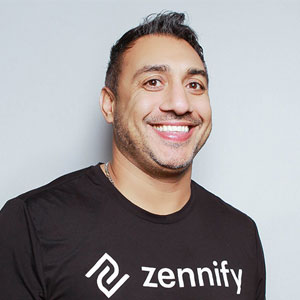
Manvir Sandhu is the Founder and Chief Innovation Officer at Zennify, a Salesforce consulting firm that helps financial services organizations drive digital transformation across platforms like Salesforce, Databricks, and AI. Under his leadership, Zennify has become a trusted advisor to CIOs and C-suite executives, earned Platinum-level Salesforce partner status and scaled to over 150 employees, serving clients ranging from regional banks to large enterprises.
Known for leading innovative initiatives, Manvir helped spearhead a vaccine supply chain solution in Haiti with UNICEF and the Clinton Foundation, which was presented at Salesforce Dreamforce. He brings a strong focus on AI, agile transformation, and change management to regulated industries.






Here’s a glimpse of what you’ll learn:
- [3:29] Manvir Sandhu explains how fintechs and banks win with digital transformation
- [4:29] Why narrowing your niche beats trying to be everything to everyone
- [6:48] How Manvir used IoT and Salesforce to transform vaccine delivery in Haiti
- [9:57] The real-time data breakthrough that saved millions in medicine and reset global standards
- [12:29] Manvir’s playbook for modernizing legacy banking systems with CRM
- [15:24] The secret behind fast, high-impact proof-of-concept projects that actually scale
- [23:59] Practical, high-value AI use cases that go far beyond basic automation
In this episode…
Digital transformation is reshaping entire industries, yet organizations in highly regulated sectors often struggle to choose the right tools and execute change effectively. As AI, data platforms, and compliance requirements evolve at breakneck speed, innovation can stall under the weight of risk and resistance. How are today’s leaders pushing past these barriers to create secure, lasting transformation?
For Manvir Sandhu, a digital transformation and AI innovation leader, lasting impact comes from pairing deep industry understanding with a practical, iterative mindset. He traces this philosophy back to his early work in healthcare, where his team reimagined post-disaster vaccine management in Haiti by combining Salesforce and IoT to enable real-time tracking and alerts — an approach that later became a model for broader adoption. Building on those lessons, Manvir pivoted to financial services, using focused proof-of-concept projects to earn trust, modernize legacy systems, and deliver a true 360-degree customer view. His experience demonstrates how thoughtfully applied AI can move far beyond basic automation to drive meaningful operational and customer impact.
In this episode of the Inspired Insider Podcast, Dr. Jeremy Weisz sits down with Manvir Sandhu, Founder and Chief Innovation Officer of Zennify, to explore data-driven transformation in highly regulated industries. They discuss proof-of-concept strategies, agile change management, and practical AI use cases across healthcare and financial services. Manvir also shares insights on empowering early adopters, navigating growth, and maintaining culture through leadership transitions.
Resources mentioned in this episode:
Special mentions:
- Philip Paz on LinkedIn
- Tami Miller on LinkedIn
- Shawn Murray on LinkedIn
- Chris Conant on LinkedIn
- Michael Rouleau on LinkedIn
Related episodes:
- The Pixar Story: The Letter of a lifetime That Started Everything With Alvy Ray Smith, Co-Founder of Pixar on the Inspired Insider Podcast
- [SaaS Series] Revolutionizing Data Exploration for Everyone With Mike Palmer on the Inspired Insider Podcast
Quotable moments:
- “You have to bring calm to the chaos — technology transformation doesn’t have to be a pressure cooker situation.”
- “Proof of concept isn’t just a project — it’s how you build trust when clients are most skeptical.”
- “The more you contextualize technology with business realities, the more effective your solutions become.”
- “Real innovation happens when you find the early adopters, listen closely, and make them champions of change.”
- “With AI, there’s no other way; you prove value through iterative cycles, not by going from zero to a hundred.”
Action steps:
- Embrace agile, iterative innovation: Use short, focused project cycles to deliver early wins, reduce risk, and build stakeholder trust for broader transformation in regulated environments.
- Prioritize proof of concept initiatives: Launch small, targeted projects to validate technology impact, minimize risk, and secure buy-in without large upfront investments.
- Involve early adopters and champions: Engage influential users early to gather practical feedback and accelerate adoption through peer-led change.
- Leverage data-driven AI for meaningful use cases: Apply AI to high-impact problems like process automation, next-best actions, and customer service improvements to drive real value and productivity gains.
- Invest in ongoing education and cross-functional expertise: Build continuous learning and industry-aligned technical skills to improve decision-making, implementation success, and resilience through change.
Sponsor for this episode
At Rise25 we help B2B businesses give to and connect to your ‘Dream 200’ relationships and partnerships.
We help you cultivate amazing relationships in 2 ways.
#1 Podcasting
#2 Strategic Gifting
#1 Our Predictable Podcast ROI Program
At Rise25, we’re committed to helping you connect with your Dream 200 referral partners, clients, and strategic partners through our done-for-you podcast solution.
We’re a professional podcast production agency that makes creating a podcast effortless. Since 2009, our proven system has helped thousands of B2B businesses build strong relationships with referral partners, clients, and audiences without doing the hard work.
What do you need to start a podcast?
When you use our proven system, all you need is an idea and a voice. We handle the strategy, production, and distribution – you just need to show up and talk.
The Rise25 podcasting solution is designed to help you build a profitable podcast. This requires a specific strategy, and we’ve got that down pat. We focus on making sure you have a direct path to ROI, which is the most important component. Plus, our podcast production company takes any heavy lifting of production and distribution off your plate.
We make distribution easy.
We’ll distribute each episode across more than 11 unique channels, including iTunes, Spotify, and Amazon Podcasts. We’ll also create copy for each episode and promote your show across social media.
Cofounders Dr. Jeremy Weisz and John Corcoran credit podcasting as being the best thing they have ever done for their businesses. Podcasting connected them with the founders/CEOs of P90x, Atari, Einstein Bagels, Mattel, Rx Bars, YPO, EO, Lending Tree, Freshdesk, and many more.
The relationships you form through podcasting run deep. Jeremy and John became business partners through podcasting. They have even gone on family vacations and attended weddings of guests who have been on the podcast.
Podcast production has a lot of moving parts and is a big commitment on our end; we only want to work with people who are committed to their business and to cultivating amazing relationships.
Are you considering launching a podcast to acquire partnerships, clients, and referrals? Would you like to work with a podcast agency that wants you to win?
Rise25 Cofounders, Dr. Jeremy Weisz and John Corcoran, have been podcasting and advising about podcasting since 2008.
#2 Our Comprehensive Corporate Gifting Program
Elevate business relationships with customers, partners, staff, and prospects through gifting.
At Rise25, thoughtful and consistent gifting is a key component of staying top of mind and helps build lasting business relationships. Our corporate gift program is designed to simplify your process by delivering a full-service corporate gifting program — from sourcing and hand selecting the best gifts to expert packaging, custom branding, reliable shipping, and personalized messaging on your branded stationary.
Our done-for-you corporate gifting service ensures that your referral partners, prospects, and clients receive personalized touchpoints that enhance your business gifting efforts and provide a refined executive gifting experience. Whether you’re looking to impress key stakeholders or boost client loyalty, our comprehensive approach makes it easy and affordable.
Discover how Rise25’s personalized corporate gifting program can help you create lasting impressions. Get started today and experience the difference a strategic gifting approach can make.
Email us through our contact form.
You can learn more and watch a video on how it works here: https://rise25.com/giftprogram/
Contact us now at [email protected] or message us here https://rise25.com/contact/
Insider Stories from Top Leaders & Entrepreneurs…
Episode Transcript
Intro: 00:15
You are listening to Inspired Insider with your host, Dr. Jeremy Weisz.
Dr. Jeremy Weisz: 00:22
Dr. Jeremy Weisz here, founder of InspiredInsider.com where I talk with inspirational entrepreneurs and leaders. Today is no different. I have Manvir Sandhu. You can check them out at Zennify.com. It’s z e n n i f y dot com.
Before I formally introduce you, I always like to point out some other episodes of the podcast people should check out. You know, we were chatting before we hit record about just data, AI and enterprise and kind of the cycles that we navigate in business. It made me think of a couple companies. I had the co-founder of Pixar, Alva Ray Smith on. And you know, when they first started, like they had to kind of wait for the technology to catch up to create these things. It’s just interesting, these cycles that people go through. And he talked about some good Steve Jobs stories, etcetera.
Also, Mike Palmer, CEO of Sigma Computing, talked. You know, they do as you stated. It’s kind of Excel on steroids. But they do analysis, business intelligence, accessibility and other things so people can check that episode out. They grew from going from 2 million to 100 million in just over three years. So it was pretty remarkable. You know, just journey there. So check that out on InspiredInsider.com.
This episode is brought to you by Rise25. At Rise25, we help businesses give to and connect their dream relationships and partnerships. We do that in a few ways. One, we’re an easy button for a company to launch and run a podcast. We do the strategy, the accountability, and the full execution production behind the scenes.
Number two, we’re an easy button for a company’s gifting, so we make gifting and staying top of mind. It could be clients, partners, prospects, staff from a culture perspective. It’s simple, easy, and affordable. You just give us the list. We do everything else. It’s not kind of like a one off gift. We like to send the think three gifts a year for four years or more. So it’s just the gift for me that keeps giving to people.
And we kind of call ourselves the magic elves that run in the background and make it stress free for a company to build amazing relationships. Because that’s the number one thing in my life. One I’ve, you know, found no better way over the past decade to profile the people and companies I admire on the podcast, and to send them sweet treats in the mail. So check out rise25.com to learn more.
I’m excited to introduce Manvir Sandhu as the founder and Chief Innovation Officer of Zennify. He leads the firm’s data and AI practices and drives digital transformation for leading financial institutions. They’re a trusted advisor to CIOs, C-suite executives, and they really specialize in modern data architectures. Gen AI Agentic AI strategic technology investments across platforms. Think Salesforce, Databricks, Snowflake, and many more. So Manvir, thanks for joining me.
Manvir Sandhu: 03:21
Happy to be here. Thanks for having me.
Dr. Jeremy Weisz: 03:23
I’m going to just tell people about Zennify and what you do, and I’m going to pull up the site as you do that.
Manvir Sandhu: 03:29
Yeah. So our primary customer base is in financial services. So we work with a lot of regional banks and credit unions, wealth institutions and insurance institutions. And you know, it’s a great time for those institutions and that technology is available for them to, you know, drastically improve their businesses.
But oftentimes they need assistance with, you know, which technology should they go with? How do they implement them? How do they architect? How do you do change management? So our role is really to help them through those transformations and get the most out of that technology from an outcomes perspective. And so, you know, we’re really critical to their strategies. And it’s a great space.
Dr. Jeremy Weisz: 04:12
Talk about, I’d love to hear about the evolution of this kind of niche for a second. Right. Where do you start? And you know it’s a lot. This seems like a very, you know, regulated and complicated type of client, actually.
Manvir Sandhu: 04:29
Yeah, absolutely. You know, it all starts with, you know, in the early stages, you end up sort of navigating and trying different things. You know, we were kind of selling to all walks of life, you know, from small businesses to public sector departments to healthcare to financial services. And you know, the deeper that you go in any one of those industries, there’s a set of norms and nuances. And one of those is what you just said is the regulatory environment.
So we actually started in the healthcare space and did some great work there, but just at the size that we were, you know, at that time, trying to scale up to overcome some of the regulatory issues was a little more challenging. We actually found a bit more success in financial services. You know, we had done some great work with some regional banks and some wealth management institutions.
And once you have success in an industry and you start to build momentum, you know, you’re at a point where you kind of decide, like, hey, do we want to keep doing sort of be all things to all people? Or do we want to focus our efforts and really, you know, double down in this space? And that’s kind of what we did in financial services. I actually ended up hiring a lot of people from industry. I mean, some of my best people are people that I hired that were bankers, you know. And so they kind of walked the walk.
Dr. Jeremy Weisz: 05:59
They brought the expertise also.
Manvir Sandhu: 06:01
Absolutely. So that’s been great for our business. You know, and as technology consultants, the ones that can really understand the business and the inside out, you know, not just the technology but the, you know, the different motions and processes and what drives profitability, what drives growth, what’s going on with interest rates and the macro. The more you can sort of contextualize that in relation to the technology, the more effective you can be, including the regulatory environment. To your point.
Dr. Jeremy Weisz: 06:32
You know what’s interesting, Manvir, if you asked me to predict which one would end up being stronger. Obviously, I would guess the health and life sciences because you really started off as a company. You want to talk a little bit about how you helped with vaccines early on.
Manvir Sandhu: 06:48
Yeah, it was a very interesting start. You know, we were doing some work with the Clinton Foundation and Unicef, and we had done some work with them in Africa, in Kenya. And they were, you know, they were pretty impressed with that work. And so they invited us to work on a challenge in Haiti, which was post the earthquake, you know, in 2010. And the challenge was around vaccine spoilage.
There was fear that, you know, upwards to, you know, 60, 70% of the medication had been compromised, but they really didn’t have data and tools to kind of understand what was going on. And so when we came in, you know, we embraced the challenge. We spent several weeks out in the field really studying processes, understanding the supply chain, the cold chain, understanding kind of what are some of the root causes. And we kind of landed at a hypothesis and we felt that technology could be a key part of the solution. And at the time, Salesforce had actually donated free enterprise licenses to the country, which was amazing.
And we obviously knew Salesforce. And we’re very, you know, thrilled about that solution. And so we sort of went to the country and said, hey, you know, we think Salesforce can help you. And they were like, well, what are we going to do with sales technology? Right. Like it’s you know, it’s a developing world nation. It’s not like they’re super tech savvy and tech forward. And so they were kind of like, we like you guys a lot. But you know we don’t know if this is going to work. And we definitely can’t pay you. And so we were like okay well that’s.
Dr. Jeremy Weisz: 08:31
A great combination man. We don’t know if it’s gonna work and we can’t pay you.
Manvir Sandhu: 08:34
Yeah. We can’t pay you. Not right. Not first, not right away. So we you know, at that point we kind of incorporated and started the company and we said, hey, let’s take this one on and figure it out. You know, we were really committed at that point.
And so we basically we utilized Salesforce and but we had these devices configured, these IoT devices. And the project was called Fridges at Talk. And basically we, you know, installed these devices, configured them, and configured the Salesforce platform as kind of the overall sort of communication management solution, information management solution. And so what would happen is, you know, if a refrigerator went out of temperature compliance, it would trigger a text alert to the local Ministry of Health worker to let them know that, hey, we have a problem in this clinic.
And then they had this sort of window to get back and triage and fix the situation, get the fridge back up to the normal temperature. What we learned through several studies in weeks and weeks of this is that a lot of the power outages were intermittent, and the power would actually come right back on. And so what they were doing in their current state was saying, oh, the power went out today. We lost, you know, viability of the temperature, so they would throw all the medicine away. Whereas in the new World they were able to sort of either triage the situation.
Dr. Jeremy Weisz: 09:50
It could have been like the 30s that it came back on, but they just figured it went out. So that went bad.
Manvir Sandhu: 09:57
That’s right. So that timestamp was really critical. And then just having access to data and analytics across the clinics to understand patterns. So that was a really effective solution. It you know, it was published in a medical journal.
It became kind of a standard for how you do this type of work, you know, especially in countries where you’ve got power issues and, you know, vaccine challenges. And this was during a time of a tuberculosis and cholera breakout. So, you know, it was a very effective time to come in and kind of put us on the map. Salesforce loved the project. You know, they loved the fridges that talked about the concept and IoT was big during that time frame. That was like 2011, 2012.
And so we were on the big stage at Salesforce at Dreamforce. Speaking about this project and kind of like that’s how identity really got its initial you know momentum and and start. So it’s been amazing ever since then.
Dr. Jeremy Weisz: 10:54
So you used it for that basically like if someone has a conversation or they hit a website, it obviously texts and emails, but you are using that almost from a government perspective, like it triggered. Okay, let’s alert whoever’s going to fix this thing. So the vaccines don’t go out, which seems like a very unique way to use Salesforce.
Manvir Sandhu: 11:17
Absolutely. And they love that it’s being used in that way. You know. And since then they’ve done a ton of innovations in the healthcare space. And you know their platform, it plays a big role in terms of, you know, how providers, you know, either in insurance or in healthcare, you know, can manage patient engagement and have that all in a secure environment. You know, I think that’s one of the values that Salesforce brings. And platforms like Salesforce is the the governance, the security, the compliance to give people the assurances that that data is protected. It’s not going to be breached. And that’s just incredibly important, especially during the era of AI.
Dr. Jeremy Weisz: 12:03
Yeah, I mean, it’s also just having the data and then it’s protected because most of like what you put in place is they actually have data. Before there was no data or very, just very, you know, big picture data, which wasn’t as helpful to make actual decisions. I’m wondering what’s the next major milestone client and what was their use case? Because maybe it’s a lot different from the first one.
Manvir Sandhu: 12:29
Yeah, yeah, I’d say the other big one that came, you know, shortly thereafter was, it was a financial institution. And, you know, they a lot of these financial institutions, when you think about just basic CRM, you know, and and how they engage their customers, you know, there’s still, you know, even to this day, there’s there’s a significant amount of, of institutions that use kind of homegrown systems. Or they go with, you know, with a solution that’s suboptimal.
So, for example, a lot of financial institutions work with like big companies like Pfizer or, you know, Jack Henry and some of these other institutions, and they’ll sort of say, okay, yeah, like we built this core core banking platform or core wealth management platform. And we also have a CRM that sort of goes with it.
So we can be your everything. Right. And you know, the challenge with that is, is that like organizations don’t necessarily know better, you know. And so it takes a trusted advisor to come in and say, okay, well let’s show you what the experience is like in the way you’re doing it today, leveraging those tools versus how it could look in a modern environment. So one of the things we did in Haiti that we leveraged and continued to do to this day is the concept of a proof of concept.
So when you’re a smaller company and you’re working with a larger institution, or if you’re, you know, if you’re dealing with a country, an entire country like Haiti, and the other side is sort of looking at you and saying, I like you, but I don’t know if I fully trust you or I trust the solution that you’re pitching. So one way to mitigate that is to do rather than like big expensive projects, you know, very agile, iterative proof of concepts to prove to the client that the technology can actually work in their environment and they can see it in action.
And so with that financial institution, we took a very similar approach in that we said, okay, well, let us show you, You know what the tool can do. And in that case, it was Salesforce. And when they actually saw what Salesforce could do for them compared to what their legacy was, it was like what.
[Continue to Page 2]