
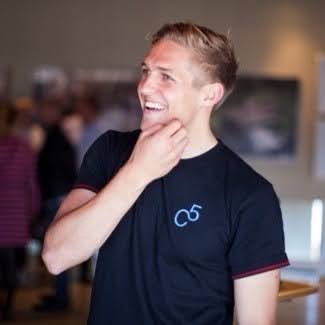
Dr. Jeremy Weisz: 05:35
I’m curious, going in, what was your expectation like? What were you hoping was going to happen?
Rasmus Barfred: 05:41
So we were hoping what happened was basically what we’re hoping for, right? We went in, and we presented the company with all the ideas. Five, six minutes in, it was more about the sharks pitching themselves to us than us pitching ourselves to the company. That sounds a little cocky, but that’s actually how it ended up being. We ended up getting offers for all the sharks, and it was about figuring out what to do and who to go with. We ended up going with Robert, and the deal we ended up doing was $1 million for 6.5% of the business, which was like what we had hoped for in our best-case category of outcomes.
So, so that was amazing. And then afterwards, the fact that Mark Cuban joined the company, called us and asked if we were okay, that he would take half the investment. I was like, no shit, Sherlock kind of decision. Of course, we wanted you to get in, right? And then the other thing was like six months later, the guy who was a guest on the show, Nirav Tolia, he joined us as an investor as well. So we actually have three Shark Tank guys on the cap table, which is cool. It’s quite funny.
Dr. Jeremy Weisz: 06:54
What about can you talk about any advice they’ve given you in the journey so far?
Rasmus Barfred: 06:59
So I would say near the third guy who joined has been really good about thinking, pushing us on how to think about the bigger picture, shareholder value, when to use our technology, when not to think about that, and just stay in our lane. Just keep in the swim lane. Go here. Cuban’s team has been tremendous, like the amount of resources that he’s basically designed for the company where he has all his investments. And there’s like, there’s consultants in that company. So there’s a really good fundraiser guy.
There’s a really good marketing guy, a really good XYZ. So that’s kind of it, it feels like I have a light consultancy on call that I can call if I want any input and feedback. And for a startup, that’s just extremely valuable. You have so many decisions that you need to make, and I don’t have a thousand employees and experts in all fields. So being able to call someone if I’m in doubt or something is just super valuable. I can’t pinpoint one thing that my team did for us. It’s more like it’s a lot of things where they have helped with, yeah, honestly, small, big things. So that’s, that’s been super, super.
Dr. Jeremy Weisz: 08:11
We’re getting into the journey, the evolution of the product. Before we do, I’ll formally introduce you, Rasmus. We jumped right in. But this episode is brought to you by Rise25. At Rise25, we help businesses connect to their dream relationships and partnerships. We do that in a few ways. One, we’re an easy button for a company to launch and run a podcast. We do the strategy, accountability, and full execution production. Number two, we’re an easy button for companies gifting. So, you know, we make gifting and staying top of mind for clients, partners, prospects, even from a cultural perspective, sending to staff. You just send us the addresses, and we’ll do everything else. And it’s, we’re not sending like, you know, branded tchotchkes. Rasmus, but it’s more like food. I like getting food. So we send things to our best relationships every three to four months. For five years, we’ll send something nice in the mail that they can enjoy with their family or whatever it is.
So we kind of call ourselves the magic elves that run in the background to make it stress-free for companies to build amazing relationships. So, I found no better way over the past 15 years to profile the people I admire in the podcast and send them sweet treats in the mail. So check out Rise25.com or email [email protected].
He’s the Co-founder of THEMAGIC5, which I mentioned. He helped build it into a globally recognized brand known for its custom-fit swim goggles, right? They use a proprietary facial scanning and advanced manufacturing, which he already mentioned, to create these form-fit goggles. The company is really at the intersection of sports design, cutting-edge tech, and it’s really driven by a mission to eliminate compromise and performance gear, and it came out of their own need. So Rasmus, thanks for joining me officially.
Rasmus Barfred: 09:56
Thank you. Thank you for having me.
Dr. Jeremy Weisz: 09:58
We’ll start from the beginning. I know that you are co-founder, I think, is also a family member, and had this issue. And we’ll talk about what some of the struggles were in the first product and what that looks like. And I’ll just say before you answer that, you know, I tore my meniscus then, so I couldn’t really do a lot of things, but I could swim. And so I started swimming a couple of years ago, and I went through maybe seven different pairs of goggles.
Okay. And I was swimming like, you know, six days a week or something like that. And they would rip. They were foggy, they would break, they would leak. They would.
I mean, it’s so annoying to stop in the middle. I’m like, there’s gotta be something that I can just literally wear for an hour. And it’d be fine, you know, and I don’t. I might even retarget it on Facebook. You guys do great marketing, and I’m like, this is it. I was probably clicking on different swimming things. And so I ordered three pairs, and shockingly, for a custom-fit goggle, they’re very, very, very affordable. So I mean, I paid way more money just going through like two pairs of goggles. And I would for yours. So, anyway, thanks for creating what you do. It makes my life easier.
Rasmus Barfred: 11:22
Amazing. Well, that was a great sales pitch right there. I’ll just, I’ll just take that and stick with that, to be honest.
Dr. Jeremy Weisz: 11:28
But talk about maybe the evolution of the product, right? Because I’m sure the first version looks a lot different from what it is now.
Rasmus Barfred: 11:36
Yeah, I’ll do that. So we launched a product on Kickstarter years ago, right? Got 2000 customers in, and I’ll be forever grateful for those guys because there’s a lot of things we had to learn on the hardware side of things, how you make goggles, but that’s more the boring stuff, to be honest. Like, how do you make sure the temples don’t fall off and all that stuff? What we’re focused on is how to create a fit profile so that the goggles, the curvature of the gasket. You can see it at the top of the website here, the curvature of the gasket. How do I make sure that the curvature fits your exact eye socket? Right. And that’s really the mission-critical thing here.
If I can make that fit your eye socket perfectly, you can wear the goggles with minimal tension on the straps, so they’re comfortable, and they won’t leak at the same time. And that’s basically what you want from a cargo, right? You want it to fit your face, and you want it to be comfortable while fitting your face. The first 2000 customers on Kickstarter, they were fundamentally different than what we had expected. We had expected them to have different faces, of course, but we thought that it would be younger, fitter, pro swimmers who would back us on Kickstarter. That was not the case. The challenge for us was in our prototyping.
We had access to the Danish national team of swimmers and swimmers in Denmark. So we have developed the first principle for our fitting algorithm based on very fit people and young people. So when we suddenly got 2000 fundamentally different typefaces over here, our fitting algorithm didn’t do a really good job in the beginning. So we had to go in and work with all these Kickstarter customers, get their feedback, and figure out what was going on. What it really did was validate the need for our product, right? But our software, our tech, and our data were not ready from day one. So that was a challenge. But we got through it.
And eventually, we had a level today where, like, we’ve shipped almost half a million goggles, have tons of customers, all different types of faces you can imagine. Right? So, our ability to create fit profiles. Like, it doesn’t really matter whether you are the Michael Phelps of the world or you’re my mom, who is 60 and swims recreationally. Right? We can do the job. But that was like a huge evolutionary step and something that you, you can’t just get like a load of 500, 000 face scans and then do the perfect algorithm. It’s an iterative process that takes time. So, okay, feedback from a thousand people. How do we implement that into the technology?
At some point, we got that advance so we could create a closed feedback loop. So all of our happy customers would take the feedback from a nine or a ten NPS and say, ” Okay, Jeremy gave us a nine or gave us a ten. And then we would tell our algorithm. He amplified the learning of Jeremy’s fit, right? And on the other side, if someone wasn’t happy, we would tell the system, Don’t learn from this fit. We did something wrong. But that’s, that was like a big evolutionary driver when we got to that mass where we could automate that feedback loop, if that makes sense.
Dr. Jeremy Weisz: 14:55
It’s funny you say that because, like, when I swim really early, I don’t think anyone’s under 70 years old. Like, like everyone’s older, you know? So it’s funny though, but talk about, I mean, your background a little bit, because where do you start? Right? Because, like you have software and hardware, each one of those individually is tough enough. And then you’re combining the two of them, and you’re saying algorithm like this is like normal, but like when you first started this, how did you even know what to do?
Rasmus Barfred: 15:27
So we, we honestly didn’t on the hardware side. So we traveled to Asia, where the hardware part of the goggles is made. And then we learned that my background is that I’m lucky to have two really good co-founders. One of our co-founders has naturally moved on. It makes sense for his career. Yeah. So that’s undramatic. But we have a really good set of competencies together to understand both hardware and software. We my, my background is that I started my first company when I was 18. Yeah, this is Niklas and my two co-founders.
Bo is a software engineer, but worked a lot in management, and Niklas was a pro swimmer. Niklas and I met at university, where we studied international business and political science. So, Niklas and I had the ability to understand the principles that go into our technology. Bo was able to shed light on it, if that makes sense. Now we have moved on from just the three of us. But from the get-go, we all have an entrepreneurial mindset. So if there’s something you don’t know, you go out, and you learn it, and you figure it out. Made a lot of mistakes along the way. And I think that’s that’s that’s a short answer to it.
Dr. Jeremy Weisz: 16:54
No, I mean, it’s interesting because, you know, you really went to the source where a lot of goggles are made, and learned from some of the pros at the time. Obviously, they’re not doing custom stuff, but they’re just kind of mass-producing them and going from there. And there’s a software evolution. There’s also the hardware evolution as well. And I could see that. And you keep perfecting that. My question is then, okay, now you spent all this time, energy, and money doing this, then how do you get out in the world? Right? So Kickstarter with the initial batch of people, but you grow from there. So talk about some of the inflection points of how you get it out to more people.
Rasmus Barfred: 17:38
Yeah. So, so what we learned from Kickstarter as well, and the initial push is on performance marketing, and that stuff was the target market that we had envisioned to launch. It wasn’t really the first market we should go after. We thought that we should focus on your competitive college. When my high school swimmer. Dedicated master swimmer in the US and Europe. Right. What we learned very quickly was that your average Joe Tech interested recreational swimmer was much easier to convert in the short run. So that’s basically how we built the backbone of the business, started focusing on, on, on those segments that then moved into triathlon.
Triathletes are very much like gear nerds, and they used to spend like $10,000 on a bike. So for them, spending 90 bucks on a goggle is a drop in the ocean. It’s how much they use nutrition products on a weekly basis, right? Where the swimming mentality is a little bit different. It’s a sport that is a little bit more minimalist in its way of using equipment, and all those things. Like it’s, it’s not that deep on equipment. Also, a sport that prides itself on having low barriers to entry, which is great in many ways, but it meant that we decided that we wanted to wait, focusing on the competitive market until we saw organic traction in that space. And that really happened two and a half years ago.
Two years ago, we started to see organic traction in the broader competitive swim market. And then since then, we’ve started to double down on that market. You can say that you built your brand on your hero users, on the dedicated users, and the guys who love swimming. So, so I, I won’t build my brand on my, my mom, my mom, not because she’s my mom, but like she’s a swimmer. Swimming is not a huge part of her life. Right? But you have master swimmers who are as old as my mom, but swim five, seven times a week and travel for competitions, right? That’s a core user. And that’s where we’re really focusing our efforts now. Yeah.
Dr. Jeremy Weisz: 19:47
So talk about maybe some of these, and we’re looking at, if you’re listening to the audio, we’re on the themagic5.com page, and there’s an athlete’s page. So I don’t know, there’s a fun story around how you got in front of one of these ambassadors.
Rasmus Barfred: 20:02
Yeah. So that’s possible with Matthew Grevers, Matt Grevers, for instance, like in the second row, Matt Grevers was, I would say, the first really big name in swimming that adopted our product. And he ended up being an equity partner in the business. Matt has a long, long, very, very crazy swim career, multiple Olympic participation medals, and whatnot. And he’s a, he’s a big brand in the US on the swim side. And he adopted the product early, maybe also a little bit too early in terms of using his likeness to go into the swim world. But he has been really valuable as an advisor when we should double down on the space. And if you look at the edit page now, it’s it looks very different than what it did a couple of years ago.
A couple of years ago, it would have been triathletes. Only now it’s really moving into that mix of, of, of more swim athletes. I will say these two guys, Jan Frodeno, are the greatest of all time in triathlon. He also invested in the business like Matt, Casper, whom you hovered over. He’s the world champion in the long-distance Ironman race. This year. And Hayden. Hayden Wilde, just above him, is the new biggest name on the block. So it’s not like we don’t work with triathletes. There’s still a big part of our brand and our marketing. This guy, these are basically the three biggest guys on the scene right now. But you have a lot more swimmers in the mix now. Yeah.
Dr. Jeremy Weisz: 21:37
How did Matt and Jan find out about you? Was it just that you reached out to them? Did they just find out randomly? How did that happen?
Rasmus Barfred: 21:45
So, Matt was it was actually his agent back then who said that Matt was interested in trying the product. He had a long-term partner, and I don’t know the story there, but he was interested, and he heard about it. Want to try the product. And then we worked with him for a couple of weeks. Matt is a backstroker. So he had some very particular needs and how he wanted the goggles to fit. So he, instead of getting our normal fit profile, we actually went in like a tailor and manually created the product that he wanted because he was like.
I want a product that is your normal fit profile for my practice, but I want a fundamentally different type of fit when I race, because I race, when I race, I go so fast. So when we do backstroke, right? You look at the, the, the lane, the flats across on top of the pool. And he was like, I want my view to be projected even more forward. So we went in and made it like a couple to cater to the needs that he wanted for that particular event. And he was like, Okay, if you can do this. I mean, I’m all in. And then he joined. He joined the company.
Dr. Jeremy Weisz: 22:57
So he may just have heard of it through the grapevine. Like it’s not like you reached out to him or anything like that.
Rasmus Barfred: 23:02
Maybe an app. I actually don’t know. Maybe. Yeah. And Jan Frodeno, the great, the goat of triathlon, that was actually a brand de Boer, a brand that I also admire in our space in triathlon space, makes wetsuits. They had a relationship with him. And, I had helped out de Boer with a few things. And then he, they were like, hey, should we introduce you to Jan? And they did. And then Jan became a fan of the product and the brand as well. Yeah.
Dr. Jeremy Weisz: 23:33
How did that? And we’re looking at that here with the facial scanning. What was the conversation like that went from this avid user? Love it. Ambassador to, you know, I want to put money into this company.
Rasmus Barfred: 23:47
So that’s a good question. When we talked to Jan, it was pretty it’s years ago, we were much smaller, and he was out of our league in terms of sponsorships and partnerships. So I was pretty upfront and honest and called and said, Hey, guys. Like, yeah, there’s a way bigger brain than we are. So we would love to work together, but I can’t; it can’t be a cash deal because I, we can’t afford it. And to be honest, Jan is such a big. He’s such a big asset. So he can spend his time better with other brands. But if you want to spend time with us, it’s equity upside in the long run. That makes sense. And that was really the pitch to him, and he got excited about it.
We actually started working with him during Corona or Covid-19. Right. And he, he got a product; he didn’t hear from him, and we thought we had blown it. And then he did an Iron Man full Ironman distance in his own home. So he swam in the endless pool kind of thing in his backyard. He jumped on his home trainer and cycled 180km. And then he. He ran a marathon on his own treadmill at home and had a huge sports star join him on each of those legs. But during the swim, he used our product. And that was for like, wow, he used a product we haven’t even sponsored. We haven’t done anything with him yet. And then he reached out afterwards and was like, I’m in. Yeah.
Dr. Jeremy Weisz: 25:14
That’s amazing. AI right. You are obviously, you know, to create this stuff with robotics and with algorithms. How have you as a company, adopted AI?
Rasmus Barfred: 25:29
So we and. Besides the product, and how we use these types of technologies to create the fit profiles for our customers. At the more operational level. About two years ago, we basically got rid of all our customer service offerings and developed our own by ourselves and implemented. Into our backend. It doesn’t mean that AI responds to all of our tickets, but it provides a 95% 99% solution for 80% of our tickets. So the person who does the customer service can now process hundreds of tickets per hour and do it much quicker and much better than before.
So, so, our AI integration into our backend has access to our customer, like no customer data in terms of when they ordered, when their scans got validated, when the product got shipped. So, it’s able to provide better and faster questions. But that was two years ago today. Basically all our operations operate a lot of our operations, whether it’s finance, it’s marketing, where AI tools are all over the place, and help us be much more efficient. I think our company has grown over the years, but our marketing division has shrunk because we don’t need that many people. Yeah, I do.
Dr. Jeremy Weisz: 27:07
Want to talk about the team in a second, but from the customer service side, you guys have great customer service. I’ve communicated with people there, or whoever it is, AI and people. Yeah. What are some of the most common questions you get?
Rasmus Barfred: 27:23
And whether the goggles work for kids or for my age? And then it was like, well, it doesn’t really matter what type of swimmer you are, how old you are. Well, as long as you’re ten years and above, we can create a fit that we can where we can give a fit guarantee. So that’s the thing. And there are a lot of things about like lead time and do you ship to this and that country, but more like generic generic stuff. Yeah.
Dr. Jeremy Weisz: 27:57
How often, when someone gets goggles like me, can I use them six days a week? How often? Like I know with running shoes, like, oh, every whatever number of miles or 4 to 6 months or whatever it is. What, what’s the general rule for? Got your goggles? Like, how often should someone get another pair?
Rasmus Barfred: 28:16
So this is a bit of a misconception that goggles will last forever. And yeah, they might last forever, but the experience is not the same after nine months. Right. And for 12 months or six months, depending on how much you swim. If you are wrecking your swim once or twice a week, the goggles should last a year at least if you take decent care of them. And by that I mean don’t just throw them in your definitely not swim post. Right?
Dr. Jeremy Weisz: 28:40
Good care of them. No, no, I mean, I put him back in the nice, you know, I just put him back in the nice magic containers there. Yeah, exactly. But I’m sure I’m not taking perfect care of them. Promise you that.
Rasmus Barfred: 28:52
Yeah, but but but like, if you’re rich and swim a couple times a week, once or twice a week, a year, at least if you’re a competitive swimmer and you have morning and afternoon practice, you’re good if you keep them for six months, but it’s a consumable when you swim that much. Right. And it is a pretty rough environment for a product to be in, either highly chlorinated water or salt water. So it’s. Yeah. But that’s kind of what you would expect. But hey, you’re supposed to change your running shoes after nine months. And yeah, it’s.
Dr. Jeremy Weisz: 29:26
And I know you’re always changing the technology. Rasmus. So, like for someone like me or someone who’s bought the product before, should we go in and rescan, or will the old scan be fine and just use the new technology?
Rasmus Barfred: 29:41
So what we don’t know is if you have had huge weight fluctuations, right? That can change your face a little bit. It’s not for everyone, but for some you, some people, they tend to gain weight in their face, and you feel bloated, right? And, you know, so, so that can be a thing that we can’t do that we don’t really know unless you tell us. If you are young, if you’re 12 and you get goggles again when you’re 14, I would scan again. Otherwise there’s if you scan, if you scan within the last couple of years, there’s not really a reason why you would need to scan again. If you scan 3 or 4 years ago.
Dr. Jeremy Weisz: 30:30
The only reason I ask even if someone stays the same, you’re always changing this scanning tech. I don’t know, maybe maybe not the technology itself, but you’re saying it doesn’t really matter from that standpoint.
Rasmus Barfred: 30:41
No. We will tell you if we think we need. If we need a new scan. And that’s a combination of a few different things. If we can see that your old scan was done on an old phone, where the quality of the scan was X, and now we can make it X times two. Right. We would ask you to do another scan. Yeah.
Dr. Jeremy Weisz: 31:01
From the team side. Right. You were talking about customer support marketing. Talk about the evolution of the team. Early on, it was just you and Bo. I take it. And Niklas, what did that look like? As the company evolved.
Rasmus Barfred: 31:15
So for the first couple of years, it was only us. We wanted to stay very close to everything and build everything from scratch. It meant that things took longer. But it also means that we know every single thing that’s going on in the business. Then we scaled, then we scaled. Our team, I think, followed the usual patterns like getting more customer service. People got more, got more operations and marketing people on customer service operations. Really, the first thing where we were able to fundamentally change the number of people that we needed to run the business, even though we scaled. So now we have a few part-time people who basically review what our AI tool does and then ship it out.
We could ship, ship all those tickets out automatically, and it would be fine. But we still want to weave out the mistakes here and there. And it’s not that expensive to do it on the marketing side, particularly on outreach to creators, to partners, to athletes. Content production and analytics within marketing are just fundamentally different today, right? So that’s something that has changed a lot. Creative process and creative production have also changed a lot. Good example, we just launched a new version of our website, and we paid $14,000 for it. And that’s everything from design to implementation. Five years ago, it would have been, I don’t know, 5 or 10 times that amount.
Dr. Jeremy Weisz: 32:52
Do you use Shopify? What kind of back-end do you like?
Rasmus Barfred: 32:56
Yeah, we are Shopify. Yeah. Yeah. And I think I would feel naked if I weren’t with Shopify. Yeah.
Dr. Jeremy Weisz: 33:04
What have you learned on the marketing side? Because I do know you guys have really good marketing, especially at least on Facebook. So I don’t know if there’s some learning there, or just getting in front of more people on social channels.
Rasmus Barfred: 33:20
It’s the bigger the fire, the more words it needs. Like it’s, it’s just, it’s a, and it’s a pay-to-play game. There are no free wins. There were five free wins, seven years ago on meta. Not anymore. And I’m just really, really happy that we’re not new on meta now and had to start from a cold account with no conversions on it. But we have a lot of data, and we have experience. And yeah.
Dr. Jeremy Weisz: 33:50
I’m wondering what resources there are that have helped you? It could be mentors or colleagues. It also could be favorite books like those you’ve just learned from. From a business standpoint, what are some of your favorite resources that you go to for yourself?
Rasmus Barfred: 34:10
I think I’ll point to AI again. I think that’s how. How you can use AI tools to be a sounding board. If you use it the right way. What tools do you. Use? I mostly use chat. Well, I work as a sparring partner, basically eating up build there, but I think it works really well. And what I’ve spent a lot of time on is just to figure out how to design it. So it doesn’t just agree with what I say, but challenges me and gives me that challenge. And, and that’s, that’s been a big, a big help. Then I have an old boss from like way before THEMAGIC5 who’s a good guy who knows me, but is distant enough to the business so he can ask the right questions and have a person like that on call that kind of knows a little bit of how you think and how you work and what you do. But it is decent enough not to be too woven into the details. It’s been extremely valuable.
Dr. Jeremy Weisz: 35:32
Any favorite podcasts that you listen to?
Rasmus Barfred: 35:36
And I’m. There is. I have to get my daily doses of news. So it’s honestly mostly news podcasts, and I have a few Danish ones that I don’t think I would recommend to this audience because I don’t really understand anything that’s going on there. And then I listen to The Daily every day, and a couple of other news podcasts, and NPR, independent journalism, and being unbiased and doing reporting and not opinionated news is important.
So, so that’s, that’s a fixed part of my listening. Yeah.
Dr. Jeremy Weisz: 36:21
You know, we were talking before we hit record about not losing focus on creating authentic experiences, right? In the age of AI and everything else. Talk about your thoughts on that.
Rasmus Barfred: 36:36
We spend more and more time online, the pendulum is. It can’t get further out on the AI focus. And rightly so. You should. And you should adopt, and you should work with AI. My wife works in AI. Its AI is all over the place. And if you don’t, you’ll be lost, right? You’ll you’ll be you’ll be left when the train leaves. But I think that there is like that. The contrast when the pendulum swings the other way is like, how do you become super advanced, technologically driven? But don’t lose your authentic experiences where they happen when they happen, right? So for us, like, gotta stay in the pool, gotta go out to events, gotta be with the customers and create an authentic experience. And balancing that is difficult. Like you’ve got to spend your resources on what’s trendy and where you can scale the business. But if you lose the other part. I think, at least as a sports brand, it’s going to be difficult to build the brand. Yeah.
Dr. Jeremy Weisz: 37:42
One last question. First of all, thanks for sharing the journey with everyone. Everyone can check out TheMagic5.com to learn more, especially if you know anyone who swims, as this is perfect. My last question is, is really around what’s next, right? Because there’s so much you could do with it in just swimming. There’s so much you could do with the technology. I mean, you mentioned just the customer support software you created. I mean, you could, you could branch that off, and for e-commerce brands, right? And there’s so much opportunity there. So maybe, maybe talk about what’s next with THEMAGIC5. And obviously, you talked about Vayu Sleep as well. What else is on the horizon?
Rasmus Barfred: 38:27
So for us, it’s this kind of two legs to our focus. One is the sports brand, THEMAGIC5, my everyday focus. How do we take an even bigger bite of this film space? And how do we use our technology all over the swimmer where it makes sense, not just the goggles? So that’s the next phase for us. Beyond that, how do I become a competitor to Nike and Adidas and not just Speedo Arena and TYR? Those are the three brands in swimming, right? How do I take my technology into the broader sports world, whether that’s shoes, helmet products, etc.? So that’s my primary focus on the daily operating side.
Then we have our joint venture, Vayu Sleep, which is how we bring our technology into fundamentally different industries. And sleep is a megatrend. There’s a super, super strong product market fit with our technology and our joint venture partner, David. And I can see you on the website here. David is an experienced entrepreneur in the sleep space. He’s sitting right there next to me. So, so David is the CEO of Vayu Sleep and pushed that business forward. For us, it’s shareholder value, how we can get more out of our technology. And it’s also a proof point on a license approach that we can take to the military and other industries. Yeah.
Dr. Jeremy Weisz: 39:58
First of all, thank you. I appreciate you sharing the journey, the stories. It’s been fascinating. Check out TheMagic5.com. You can check out vayusleep.com and more. And we’ll see everyone next time. Thanks so much.
Rasmus Barfred: 40:13
Thank you so much for having me.