
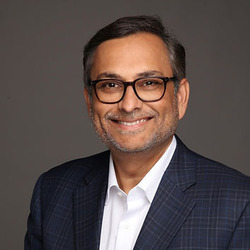
Manoj Saxena: 13:57
Yeah, that’s a great question. I think the advantage of being around and building and selling companies, like you said, that helps as a calling card. I also had the benefit of being the chairman of the US Federal Reserve Bank in San Antonio for six years. So I have a network of people that you call in and say, hey, you’ve been reading these articles from New York Times. I think this will be an issue. Do you have someone in your innovation team looking at this, and is this something on your radar?
And then I would send them a little LinkedIn post that I write as a point of view on what will happen, and then some back and forth. And you say, do you mind if I just come in and walk around the halls and talk to your team and then, you know, even maybe invite them to Cambridge, where I was teaching seminars, and have us be a part of a fireside chat. So it starts with a conversation to create value for the customer and as an information exchange. The commercial part doesn’t come in until much, much later because the initial focus is on really learning and understanding. What are the signals to focus on?
Jeremy Weisz: 15:02
It sounds like once you get into an environment like that, there’s a lot Trustwise can do. I’m wondering, do you go in to, like, a bank and say, hey, let’s just implement this one piece before of everything? What is that like as a, the onboarding look like in, in a scenario like that?
Manoj Saxena: 15:21
No. Great question. So I think the first thing we do is we say we’re in production at multiple banks, multiple high-stakes environments. We have we are, you know, agnostic to Amazon and Azure or Google or on-prem. So we lead with case studies where people have gone into production with this and are running it in very tough environments. Then we tell them we have this environment called Forge, which is like a foundry where we have a method called 10, 10, 10, 10 seconds, 10 minutes, 10 hours. So in 10s, you can get access to our Forge environment, where there is a nursery of these agents, and then in ten minutes.
You can drive these agents around a racetrack, and we will turn on and turn off Trustwise, and you will show how these things will go rogue or off policy. So you can see it for yourself in ten minutes. And then in ten hours, you can bring your own agent in and start seeing how it would behave with and without Trustwise. So that’s sort of the, you know, the credibility-building process. Show them case studies and give them references. Show them in your environment what this looks like. And then once they feel comfortable, we can say we can copy and paste this into your environment.
Jeremy Weisz: 16:32
How have you found these banks to be using AI now? Because I imagine there’s a lot of fear around this in general. Are they when you go in, is it just something they’re not implementing it at all, or they’re only implementing it in certain environments? What is the landscape look like when you go in there right now?
Manoj Saxena: 16:51
Yeah, so I think so one of the biggest things that I have seen in the banks and other areas is the conversation has shifted dramatically from, you know, two years ago or even last year. Right. So the first thing that we are seeing is the market is moving from Copilots to agents and MCP tools and APIs. So it’s not just around, okay, let me get a ChatGPT and let me get a Microsoft Copilot. They’re actually beginning to build agents. They’re beginning to expose data through MCP tools. And, and they’re beginning to then ask questions. Okay, can we control the actions of the AI?
Jeremy Weisz: 17:29
And really quickly, like, so the MCP is that controlled inside of their environment. For instance, for people who don’t know what that is, but like they’re using only, let’s say they communicate via Slack, it’s only their internal system that’s connected to that. So it’s not going outside. You find they’re using it internally. Yeah. Yeah.
Manoj Saxena: 17:51
Some of them, we need to do it externally to with some of their selected partners. But the first part where they start is I want to expose the data. Think of it as an MCP, as a next generation of an API where you can start accessing data where agents can consume and understand it. So first thing that we see is that they are now going beyond just commercial products to building agents and, and asking that second thing is they’re moving from abstract discussions on AI governance to some real deployment questions. You know, how do I make sure that it understands my policy in this context? How do I make sure I generate an audit trail? One of the CEOs of a bank said to me, it’s not a matter of if, it’s a matter of when.
I’m in front of a jury explaining why we denied a loan, and then that person, you know, harmed himself, and now we’re getting sued. How can I explain that? On June 10th, at 4 or 10 pm, what my agent did to deny that loan, what policy, what data, what tool did it use? So they’re getting into practical things like how do we build these longitudinal traces as to what they did? So that’s the second thing.
Jeremy Weisz: 19:00
That seems like it also be more defensible because if you can get that data, then it shows all the things it did. Like we’re a human, maybe like, oh, I just look at this and this to deny it. And then the agent’s like, I looked at these like 72 points.
Manoj Saxena: 19:17
Yeah.
Jeremy Weisz: 19:18
But you need to document that in the process.
Manoj Saxena: 19:21
I imagine this is the kind of stuff I think over time, AI will make us into a fairer society because of things like that, because we can actually start looking at what it did and why it did it. And the last thing it’s doing is scaling. People have now thousands of agents. One of the large global companies we work with, they said by the end of the year, they will have over 100,000 agents. And, you know, if you think of agent as a digital labor, where is the HR department, and where is the finance department for these?
That’s where the Trustwise control plane is: sort of, we are the HR Department of agents, where, you know, you would not launch a company without an HR and finance department. Why would you launch agents into a company without it? So how would you drug test an agent? How would you make sure that each agent has the right handbook, employee handbook based on the role they have? And then how do you make sure you’re doing instant performance appraisal? None of that infrastructure exists. And that’s what Trustwise is building as the control plane.
Jeremy Weisz: 20:20
So how are banks using it right now?
Manoj Saxena: 20:24
Yeah. So primarily in three big buckets. One is they have existing generative AI systems. So where they want to make sure of is that they add more data to it, and they add more access to it. These systems now, you know, they have to align with policy. So what is called as an end-user compute: a large bank that I’m working with they have over 100,000 customers who are now writing prompts that are half a page long and one page long. And these prompts go in and start accessing multiple tools. And MCP servers are all in the back end, and they need to make sure that the output that is coming by doesn’t have all the data leakage issues and policy alignment issues. So one is that is.
Jeremy Weisz: 21:05
So they’re allowing their clients or customers to access their own data, but you have to make sure that it stays within their own data is not pulling other things. So it gives access to clients and customers in a controlled security setting. Yeah, that makes sense.
Manoj Saxena: 21:21
So that’s one is employees themselves being able to use AI and write their own prompts. The second one is they’re taking existing systems like chatbots, and they’re connecting those systems to go deeper than just questions and answers to now go into, really sort of, you know, take actions on their behalf. So update policies or send renewal notices or dispatch a new credit card and stuff like that. So adding action layer on top of chatbots. The third one, probably the most exciting one, is reimagining a new class of processes. So US Bank, one of the customers we work with a great customer to have. They’re working on a shopping agent, a commerce agent. So imagine if, at OpenAI, they’re working with OpenAI and Mastercard and others, where you ask an agent, hey, go buy headphones for me.
Make sure it’s 75 bucks or less and has five hours of battery life at least. So that agent then goes shopping across different websites. How do you make sure that the agent understands your intent? That is only that much money, and it is five hours of battery life, not 4 or 3. And then, when it goes and looks up a catalog that the catalog doesn’t have something, hidden messages that will make it go off by saying hacking that agent, how do you make sure it gives the credit card to another agent and securely gets that thing back? So there is a whole chain of actions that needs to be controlled when you re-imagine agents doing work on your behalf. And that, to me, is the third and most exciting part where banks are beginning to deploy AI.
Jeremy Weisz: 22:55
It’s interesting because, like, people, I feel like, have to be good prompters in this, or there needs to be tight controls. Like I went, I’m, you know, doing a triathlon. I went to get, like, another triathlon watch. And I actually asked ChatGPT, like, what’s the best one? Here’s my criteria. And it gave me one. But then I said, I only want to buy it from the company, because like Amazon. If you searches Amazon, there could be six or more different sellers. And I don’t know if they’re reputable or not. So I could have just said, hey, buy this type of watch and it could have bought it from the wrong, it could have given me the right outcome. But maybe the wrong seller, like something happens, I don’t have the same warranty, or I can’t return it. So there’s those are real issues, even though I that’s saying I get the correct item, let alone not get the correct item.
Manoj Saxena: 23:47
Yes, yes. This is where understanding intent and aligning the AI to the intent. So we call it declared, observed, and inferred behavior. What is it that Jeremy has declared that he wants? What is it that we are observing that he typically tends to do? And what can we infer with people like him who tend to do these things? Taking all that, we provide the context to control the agent.
Jeremy Weisz: 24:14
Yeah. it’s really it’s really interesting. So banks is a use case for this. I mean, anyone who really has big sets of data that either the client, consumer, or the actual staff is, you know, needs to communicate with to get to get things. What’s some other examples of people using Trustwise?
Manoj Saxena: 24:36
So one other example is tax and audit firm that is actually using it to do audit of clients. So if you have a shoe store and you got 50 different locations and you have to run audit, you could run an agent to be able to go look up the books and decide how many audit visits each store needs and based on the condition of the books, and then match it to who are some of the auditors that should be actually scheduled? Looking up the calendar of those auditors and saying, hey, these are the ones that are available on this week in May and then be able to generate an agenda for each of those trips.
For the auditor. So essentially, orchestrating tax and financial planning and audit is one example. I have another one looking at investment banking due diligence. When I’m buying a company or looking at mergers, being able to orchestrate agents, models, and tools to be able to decide: here’s my checklist of things that we look at when we buy companies. Give me a summary report on the quality of it. Where should I go deeper? Go through the data room. Go through the market data. So, you know, every potential process and more is going to have AI woven through it like a silver thread.
And broadly, I think of it as what happened with the internet. We had internet, intranet, and extranet. Same thing is going to happen with agents. You’re going to have intranets of internal agents, extranet of agents with your partners, and an Internet of public agents. And you probably- your audience probably knows this, but I was surprised. Two months ago, the traffic on the internet agent traffic exceeded human traffic. So there is more agentic activity on the internet now than there is human activity.
Jeremy Weisz: 26:29
What would be an example of an agent traffic? What are the agents doing?
Manoj Saxena: 26:33
Going on behalf of, for example, shopping for hotels and travel stuff? So you use Perplexity and say, I want to go to someplace warm in October in Europe. I want to have this. And, you know, with some snorkeling activities, ideally with some whale watching, and then it’ll go in and then say, use my American Airlines travel miles if possible and make sure that my EA gets an email suggesting those three places to look at. So all that traffic, one input from you could trigger like 75 actions. That’s one. The other one is agents are fighting each other, like on Wikipedia today. There are tens of thousands of bots that are fighting each other. One is editing and saying, this guy was a freedom fighter. The other bot is saying he was a terrorist, and now you got traffic online. That is just non-human traffic.
Jeremy Weisz: 27:31
Yeah, I think there’s a scene from, like homeland with like, they enter like a, like, it’s just a bot farm. But, you know, it’s really interesting. One of the things that intrigues me is revenue models. Yeah. Talk about and this; I know it excites you as potential revenue models.
Manoj Saxena: 27:52
Yeah. So I think one of the big things that people are, I think we’re just sort of, I call it the dogs watching TV stage. Jeremy. Like we’re looking at AI like this and like that and saying, what does this mean in terms of not just automating processes, but if you really start kind of, you know, focusing and double clicking on where we are headed, where we’re heading to is the discovery of services or the evaluation of products like you were doing, or the consumption of information is not going to be just by the humans. It will also be by AI and agents now.
So not only are human travel agents are going to use the internet, there will be digital travel agents doing booking or reordering and querying for information, and all these non-human characters.
You can start selling products and services to them. So, for example, one of our partners is FactSet. They are like a Bloomberg and S&P. They sell data feeds today to human users who are, you know, equity analysts or, you know, investment banking portfolio creation, and all. And they may be asking, okay, I need a current consensus on this particular stock’s credit spreads, or so. And so that same query is soon now going to be done by agents. So the question becomes: what is the new revenue model for a company like FactSet, where, in addition to selling a SaaS to a human, they could now start selling SaaS to agents and get paid for it. That’s one type of model.
The second part is agents will start buying and selling compute from other machines. So if I’m running a particular model and a particular job that runs for three days, the engineering agent may realize that it needs an extra GPU two hours from now and a specialized model, and it’ll go out on the internet and start looking for who’s got the cheapest model that. So does the buying and, you know, sourcing of it and pays for it. That’s another example of a new revenue model of an agent as a middleman who is buying and selling compute capacity. Hotels and airlines can directly start selling, you know, to these agents to say, hey, if you are a Kayak agent, it’s one thing.
But if you have a Perplexity agent that I wrote, I’ll have a new marketplace where I can go in and discover it. So the number of business models that are going to come out of this is going to be just incredible. And I think we are at that stage where, with the internet, two years before e-business just took off and marketplaces took off, we are right at that place. And Stripe’s acquisition of OpenRouter for $7 billion is a good example of where it is going. Why did Stripe buy a model routing company? I mean, you double-click inside of it. You see a lot of new revenue models. And to me, that’s one of the most exciting things that we are about to step into.
Jeremy Weisz: 30:52
So go, go deeper on Stripe, OpenRouter. What what do you see there?
Manoj Saxena: 30:57
Yeah. So again, there’s a there’s a lot of data that’s, you know, published over there. So one of the big things is Stripe is in the business of connecting, you know, financial transactions and really sort of understanding where is it that the money flow is going. For example, if you have, you know, a particular payment, then then the payments business and today the payments are handled mostly by humans that are connecting to different endpoints. What the future is going to be not just humans doing information on financial transactions, but routers working on tokens and buying and selling tokens.
So, for example, if I am an agent going and buying a compute capacity, or if I’m an agent going and buying shopping stuff like, you know, speakers or headphones for you. Where is all that commerce data going? Where are all the machine transactions going? What are the agents buying? What are they issuing refunds on? Where are they ordering services? All of that data where agents are talking to agents or agents talking to different systems is billing and payment data that you can start using to create new products and new offerings and new services? So those are the kinds of examples of, I think, and we’re just at the beginning of this cycle where we’re going to start defining a whole new class of revenue models.
Jeremy Weisz: 32:33
When I, when I talk to you and I do research about some of the stuff you talk about, I think of the book Blink by Malcolm Gladwell, and there’s a part of the book where I forgot the exact timing is like there’s, you know, a coach who’s tennis within like two seconds can tell when the person throws it up if it’s going to be a fault or not. And they’re predicting the double faults, and there’s not that many of them. And I see that because, like, you have a breadth of experience; you’ll see something, and you’re like, oh yeah, that’s going to be the future. Or this, this comes from, like, all of the decades of, you know, experience you have.
So I’m curious, going back to your IBM Watson days, right? What were some things then, because you were early, early, early on to see some of this stuff, to see AI put into motion before anyone really knew what AI was? What were you seeing then that you’re like, okay, yeah, like this is going to happen? And now you’re seeing it come to fruition. And now stuff you’re seeing now may not come to fruition for five or 6 or 10 years. Right? So what were you seeing in IBM Watson days at that point that people thought you were crazy? Like you went back like, here, here’s the future. And they’re like, no, you’re insane. Okay. Yeah.
Manoj Saxena: 33:53
Yeah. You know, it’s, it’s a great question. And I actually gave a TED Talk on this, and I talked in the TED Talk about we are the last generation that will be known as Homo sapiens. We’re going to become Homo digitalis, where we are going to blend with the machine. And our knowledge is going to be that the smartphone is the beginning of it. But let me kind of go through that a little bit deeper. This whole notion of trust and and commoditization or democratization of intelligence is what I saw with Watson that has now stayed with me the rest of my life.
So at Watson, we were asking a very different question. We the question was, can a machine understand enough information to help a human expert make a better decision? So and that’s why we decided to put to work in cancer. We worked with companies like Memorial Sloan Kettering and MD Anderson, because oncology represented the kind of complex information problem that Watson was built for. Go through an enormous amount of data, rapidly changing science, and then recommend decisions for humans to make a better decision on. And I remember about a year into that, when I was giving a talk in Washington, D.C., on how we were applying it.
This guy in the fifth row, he stands up very animated, and he looks at me and says, you know, my wife has stage three breast cancer and you are building Obama’s death panel machine. You’re building a machine that will now decide whether she will live or die, because it will pick the therapies. And this machine can’t explain itself. And it’s one thing to play a game of Jeopardy with it. It’s another thing to put it to work on impacting people’s life. And that’s where, I mean, you talk about a moment that changes the direction of your life. It was that moment driving that night to the airport. I literally I was in tears, thinking, you know what?
This whole Silicon Valley mindset of move fast and break things does not apply for AI because this is going to impact people. And this as you start progressing it, particularly now when you make it, do take actions like we do now. This is going to create a massive amount of uplift as well as a lot of issues. If you are not able to make sure that these machines can be accurate, can be explainable, and can be controllable. So that sort of was a big part, which has only become bigger in the last ten years. Now we are about to unleash. I call it: we have summoned AI.
And by the way, I’ve stopped calling AI artificial intelligence. In some cases, it is alien intelligence. It is doing stuff we don’t know why it’s doing. It was not programmed to. So the thesis I had ten years ago about making these systems explainable and controllable has only become bigger. And now we’re going to have millions of these little entities about to be unleashed without proper controls on it. And that’s what both excites me and worries me. And that’s where I made my life’s work through my non-profit, the Responsible AI Institute, which I hope will get a chance to talk about a little bit.
Jeremy Weisz: 36:53
Yeah. Talk about that.
Manoj Saxena: 36:55
Yeah. So, you know, the as I started looking at this need for machines to be controllable and explainable. One of the obvious realizations to me was that this needs to be done by someone objective and independent of the vendors who are building the technology. Otherwise, people who are building their own AI will essentially be self-marking their own homework. So what I recognized ten years ago was we need an independent nonprofit that doesn’t have software to sell, doesn’t have services to sell, that can essentially help you classify, benchmark, and verify these AI systems, almost like a a Good housekeeping sign of approval or a, or a Carfax where you bring in your system. And we are able to sort of give you input on how to make it more reliable and trustworthy.
And I consider that to be my life’s work. Now, ten years later, we. Dev. Dev. dev.responsible.ai. That’s my life’s work. And now we do these AI wind tunnels and AI sandboxes where banks and healthcare organizations and regulators and boards and chief risk officers, they are all coming together into this neutral Switzerland that I have created, where they are asking each other, how do we understand this new class of systems? How do we understand how to control it? What are you learning from it? So we are sort of creating that place where people can learn from each other. I call it a do tank, not a think tank, because we actually have sandboxes, and we actually have wind tunnels that are going to actually help you see the behavior of these systems. So how are.
Jeremy Weisz: 38:39
People using the. And if you’re watching the video, we’re right here at Responsible.ai here. How are people using. Can any company go on and become a member and use this, or how does it work?
Manoj Saxena: 38:52
Yeah, absolutely. So any company can become a member at an individual level. You know, it’s up to you to pay whatever. We only member-fee-driven. But I’ll give you an example.
We launched this thing called Trust for healthcare and Trust for banking. So, NHS England on the healthcare side, last December, the Health Innovation Network of England, along with Cambridge, along with King’s Fund, they all decided to create this sandbox where they want to make sure that new AI technology, like ambient scribe. So doctors are now using AI to listen in and not taking notes, but the note-taker is doing that. As you’re conversing, how do you make sure there are no silent breaches in that? So NHS has started using Trust Health as a hub where multiple startups and big technology companies, as well as NHS hospitals, are coming in to understand what are the pitfalls of using this kind of AI in my medical processes are?
Jeremy Weisz: 39:52
Because there was a kind of, like, a virus scan on a computer. Like, once they use it inside there, it says, hey, here are the risks you have. You know, like if you run like a scan, it’s like, here’s stuff that shows up is like, what does it look like when they run it? Good.
Manoj Saxena: 40:06
Good question. Yeah. So, it’s three tiers. It’s three tiers. One is the self-marking first.
Lowest level is we will give you a tool that you can run internally, and you can answer a bunch of survey questions. And basically it will tell you where you are, like a diagnostic tool. That’s one. Second is you can come to us and say, hey, we have done this. We want to get you to verify it, in which case we will tell you, give us proof of work. We will still not take your IP or your data, but we will ask you for validation that you actually done that work.
And then third is you can take the whole thing and run it inline as part of your development cycle, where this becomes almost like a spell checker for trust. And then you send us the output, and then we will verify it to you. So it could be, you know, I call it crawl, walk, run: crawl is just take the download the tool, work internally, understand how big the gap is, like a quick diagnostic. Walk is, you know, we do it for you, but you have to give us some proof of work. A run is you take it, you run it internally, and scale it.
Jeremy Weisz: 41:09
How do you choose? You have a you have a number of team members, expert advisors, advisors talk about some of the maybe advice or, you know, thoughts that people have that are on the governing board or advisors here.
Manoj Saxena: 41:24
Yeah. So a good example here. So Suraj Srinivasan, who’s a professor at Harvard Business School, that you see, he is writing two courses on responsible AI for MBA students and executives. And his whole thesis is that the org chart hasn’t changed for the last hundred years. And now companies are going to have human labor and digital labor showing up in a company. How do future MBA students and future leaders manage an organization where you have human and digital labor working together? So that’s a good example of the course material that he’s going to create.
And then he’s going to have one of his own wind tunnels where he can say, how do you do performance appraisal of an agent? So he’s writing materials off of that, that one example, Avivah Litan, who just joined us. She’s one of the top Gartner analysts. She was she’s the leading expert on cybersecurity, a VP and distinguished analyst at Gartner. She is helping us really build out technology components of the wind tunnel to make sure that it aligns with, you know, the best of the breed, like in a Garden framework or OWASP and others. Cameron Davies, who’s a chief data officer at Yum! Brands- they’re looking at, I mean, they’re the largest restaurant chain in the world: 68,000 restaurants- Pizza Hut, Taco Bell, KFC.
They are looking at using AI for everything from helping franchisees figure out how to fix a pizza oven to doing voice ordering, and they want to make sure that they are bringing in the right case studies to us and taking the right controls from us. Matt Sanchez, who’s the vice chairman, he’s a CTO at IBM. As they build the products, they want to understand, both contribute what they’re learning as well as learn from the community. So it’s a mix of people from academic, operational, and technology that I’m honored to have sort of working with us on.
Jeremy Weisz: 43:16
Yeah. Very cool. No, thanks for sharing that. I know you talk about this- how AI will make us more human because people are people; sometimes they think the opposite.
Manoj Saxena: 43:28
Yeah. You know, that’s one of the. So let me ask you, when you hear that statement, what do you think about first?
Jeremy Weisz: 43:35
I mean, what I think about is it will allow me to do things I want to do and not things I don’t want to do. So I can actually interact with people and maybe not do busy work. That’s, that’s what my mind goes to.
Manoj Saxena: 43:47
Yeah. So I think so one of the first things I would say is AI will take away a lot of the mundane and boring stuff, and it will give us more time so we can focus on the human relationship piece, mentoring, creativity. So one, AI will give us more time so that you’re not taking notes as you’re, you know, seeing a patient, and as you’re talking to your financial advisor, you know, AI is recording it for you. So it gives you more time to connect as a relationship. Number two, AI is going to become like a our own- I call it an Iron Man Jarvis suit. So where we will have the world’s best experts available. So if I’m a clinician working on pediatric diabetes, I’ll have the power of 15,000 of the best nurses standing right behind me, tapping me on the shoulder and saying, hey.
From our memory of cases like this around the world, these are some tests you should consider running. So this cognitive exoskeleton, if you may, makes us more human, where we connect the dots, where we understand intuition, and we focus more on empathy and stuff like that. That’s the second one. The third one is AI will actually help us really tap into creativity and, you know, beyond intelligence. So, things like, how do I do so I’ll use an example. I’m a huge fan of jazz. And if you look at jazz in the 60s, there was a massive explosion of jazz because of the electronic synthesizer.
Because if I have creativity inside of me, before, I needed 6 or 7 different people to be brought together: the cello and the bassist and all. Now I have all of that in there, and I could now practice and create a lot more music. I look at AI as the electronic synthesizer for humankind in terms of creating new business models, new products, new services. Where I think it will unleash our creativity. So it’s going beyond intelligence to things that really make us more human: empathy, creativity, compassion, and communication- those types of things.
Jeremy Weisz: 46:00
I have one last question. First of all, thank you. Thanks for sharing the journey. And I can talk about this with you for hours. People can check out Trustwise.ai. My last question: you know, I just find this really interesting about your background, and also to me, random. Okay, what have you learned from racing cars? And yeah, in life, what has that taught you in life? In business, right? I don’t. It’s really interesting because you have, I think I have a team or, you know, talk about that for a second.
Manoj Saxena: 46:31
Yeah, yeah. No racing. I call racing my meditation in motion. So I have a small. My daughter says I have like a million tabs open in my brain at a given moment. But when I’m behind the wheel of this 85-year-old car, and then I also have a Ford GT, which is like one of the most modern cars, you have to focus on stuff, and it kind of gets you into that zone. And that’s my downtime. I don’t smoke, I don’t drink, I don’t do drugs. To me, racing is what makes me come alive and kind of focus. But what I’ve seen is that when you start actually looking at racing and life, there are a lot of parallels.
It is not the straight speed, how fast you can go on the straights, that makes you win or lose a race. It is how you take the corners, how you take the turns, that makes you really figure out how far you go. The second thing is also that it’s not the first turn when you come out of a race. If you don’t have a good first turn, it doesn’t mean you’re going to lose the race. You’ve got to continue to stay on, looking at the next turn and the turn behind it. So there are lots of I could even write a book on this.
Jeremy Weisz: 47:35
I was going to say it’s a good title, actually. How do you take the corners, or something that maybe that’s your next book?
Manoj Saxena: 47:41
Yeah. And the last thing is, in racing, they always tell you, don’t look at the corner in front of you; look at the corner beyond that and start getting set up for that. So I think it’s the same thing that exists for all of us in life: look at not just the next one, but the one beyond that.
Jeremy Weisz: 47:57
Love it. Well, I want to be the first one to thank you. Check out Trustwise.ai. Check out more episodes of the podcast. We’ll see everyone next time. And thanks so much.
Manoj Saxena: 48:08
Thank you. Appreciate it.